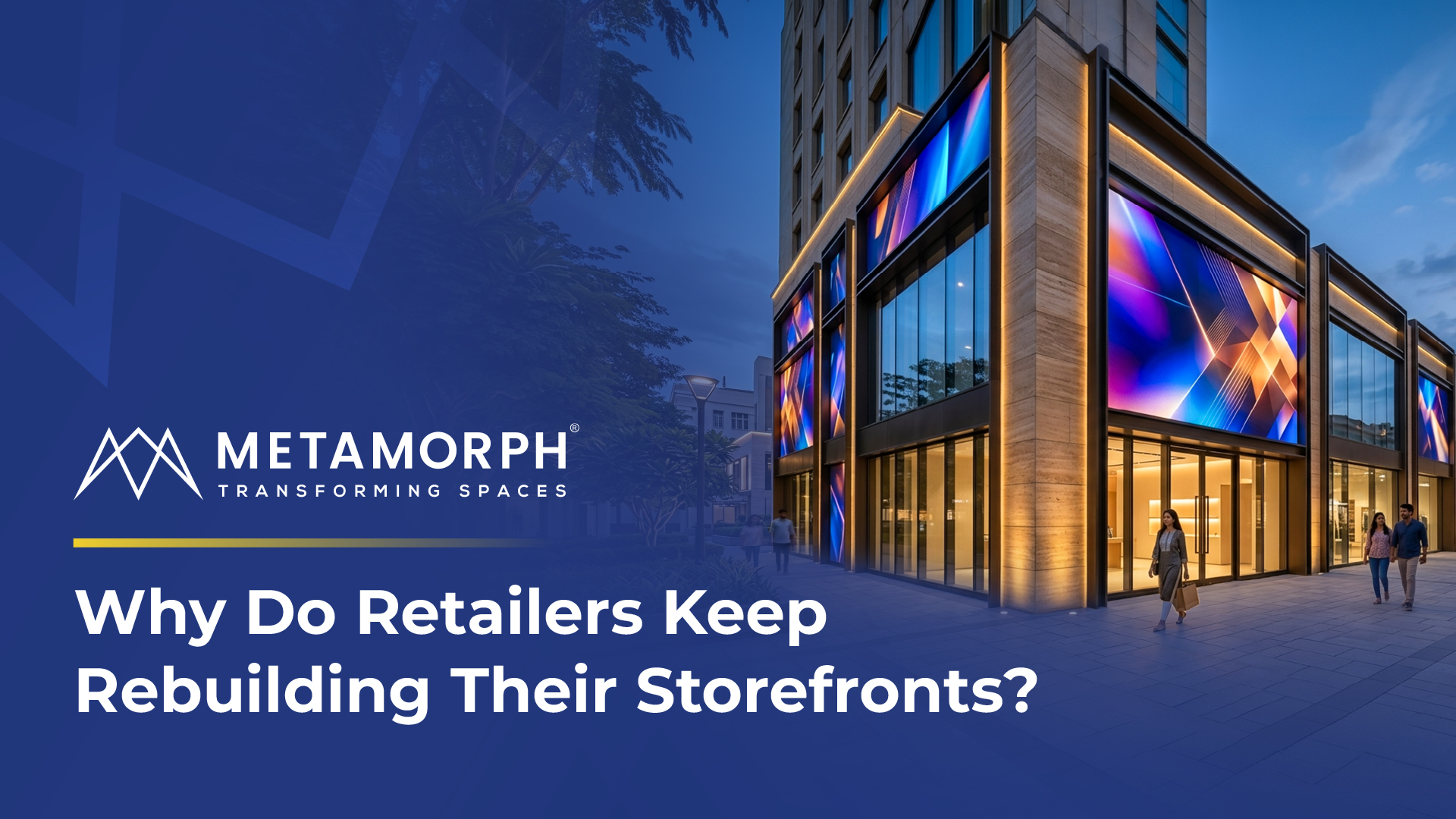
Retail storefronts appear to change more often than they once did. Campaign visuals are replaced within weeks, product launches take over entrances, and digital displays introduce new messaging without any visible change to the façade itself. What appears to be constant rebuilding is often something different entirely. Retailers are changing what the storefront communicates while the storefront itself remains largely unchanged.
A storefront had one primary responsibility. It established the identity of the business. Customers recognised the brand through its façade, signage, materials, and architectural language. Communication existed alongside that identity, but it moved at roughly the same pace. Campaigns were less frequent, product cycles were longer, and storefronts rarely needed to change between major refurbishments.
Brand identity is still designed to remain consistent over years, while communication changes throughout the year. Product launches, festive campaigns, regional promotions, collaborations, and omnichannel marketing all require the storefront to communicate something current without losing the familiarity customers associate with the brand.
That separation between identity and communication is quietly changing how storefronts are planned.
The Pace Of Communication Has Overtaken The Pace Of Architecture
The acceleration of retail communication has happened differently across every category.
A fashion retailer may introduce several collections before the season ends. A beauty brand builds visibility around frequent product launches. Consumer electronics follows product release calendars. A quick-service restaurant may run a cricket campaign, transition into a festive menu, and introduce a regional promotion within the same quarter.
A customer who discovers a campaign online increasingly expects the same communication to continue through the storefront, Retail Signage, and the in-store environment, creating a consistent experience across every touchpoint.
Retailers therefore face a planning challenge that barely existed a decade ago. The architectural identity of the store is expected to remain stable enough to build recognition across years, while the communication layer is expected to respond to business priorities that can change within days.
The storefront now supports two lifecycles that move at completely different speeds.
.jpg)
Why This Is Changing Storefront Planning
Once communication becomes continuous, the storefront can no longer be designed only as a finished architectural outcome.
It must also be planned as a communication system that will continue evolving long after the store opens.
That changes the questions retailers ask during the project itself. Instead of considering only how the façade will look on opening day, they must consider how future campaigns will appear across locations, how regional messaging will be managed, who will control content, how updates will be deployed, and whether the infrastructure can support years of changing communication without repeated physical intervention.
Electrical coordination, structural integration, maintenance access, network connectivity, and content management become planning decisions because they determine how effectively the storefront will perform throughout its operational life rather than only at handover.
The discussion has moved beyond designing the façade. It now includes designing the system that allows the façade to keep communicating.
Why Digital Signage Has Become Infrastructure
Digital Signage is often discussed as a display technology. Increasingly, retailers are planning it as part of the communication infrastructure that supports the business long after the store opens.
The shift reflects a broader operational change. When campaigns are expected to change throughout the year, updating storefront communication can no longer depend on replacing physical graphics across every location. Retailers require a system that allows marketing teams to schedule launches, regional campaigns, seasonal promotions, and product updates with the same consistency that they manage digital channels.
This changes where Digital Signage sits within a retail project. It is planned alongside the storefront because it influences how communication will function over the life of the store. Decisions around display integration, power, connectivity, content management, and long-term maintenance become part of the initial planning process rather than later additions.
The value of Digital Signage therefore extends beyond the display itself. It provides the operational capability to keep storefront communication current while allowing the architectural identity of the store to remain consistent over time.
.jpg)
Conclusion
One of the more interesting tensions in modern retail is that the storefront is expected to achieve two objectives that move at entirely different speeds.
Customers recognise a brand through consistency. They engage with a brand through communication that continues to change.
Designing for both has become one of the defining challenges of storefront strategy.
Every storefront we plan is shaped by that balance. The architectural identity is expected to serve the brand for years, while the communication system must remain responsive to everything the business will communicate between opening day and the next refurbishment. Planning those two lifecycles together has become just as important as designing the façade itself.